
















Google Featured Snippets in 2026: Are They Still Important in the Era of AI Overviews?
What Are Google Featured Snippets?
Remember when just getting on Google's page felt like you won the whole thing? Then Featured Snippets showed up. Suddenly being number one was not the end goal anymore. Brands started going after something better. "Position Zero”. That little answer box that sits above all the other results. A featured snippet is when Google takes content from a webpage to answer your question right away. If you're learning about featured snippets, this is one of the most visible positions a page can earn in search results. You will usually find these at the top of the search results. They can be text, a list, a table or even a video.
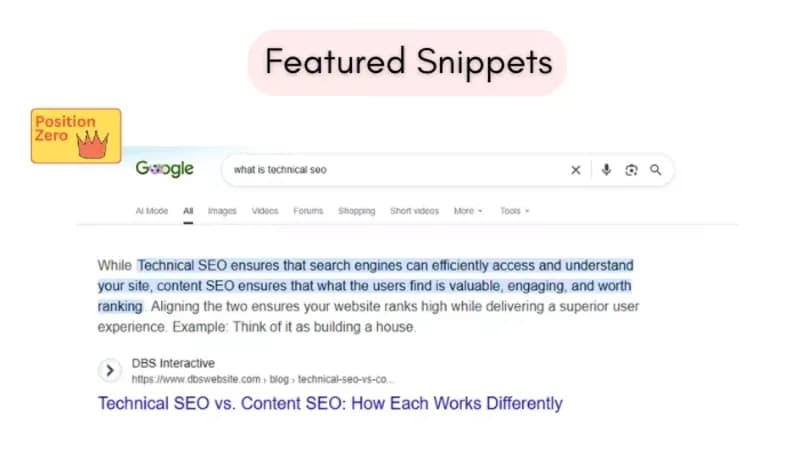
For example, when you search "how to tie a tie," Google may display the steps directly in the search results. That is why Google featured snippets are a big deal for people who do SEO. Getting one means you are more visible and you are more credible. You often get more clicks.
Here is the thing. Search has changed a lot in the last couple of years.
With Google AI Overviews becoming more prominent in search results, many marketers are asking a new question: do featured snippets still matter?
The short answer is: yes they do. They just have to change to keep up with the times.
How Featured Snippets Work
Google has one job. To give people the fastest and most useful answer it can find. This focus on delivering relevant answers is closely tied to Google's machine-learning systems. Understanding Google RankBrain and how it impacts SEO and search rankings can help marketers better align their content with user intent and search behavior. So when it finds content that answers a user's question, it will often take a piece of that content and put it at the top of the results.
Let’s say someone searches for "what's website maintenance"?
Your page has a line that says:
"Website maintenance involves frequent updates, checks & optimizations to keep your site safe, operational and easy for visitors."
This type of response is typical of what Google considers 'featured snippets' - it answers the question posed by users without excess or unnecessary content. Ultimately, Google puts a high value on providing its users with accurate descriptions, i.e. featured snippets, and helps them find answers quickly. Google also prefers featured snippets because users can quickly understand them.
Google prioritizes featured snippets that provide accurate, easy-to-understand answers.
Types of Featured Snippets
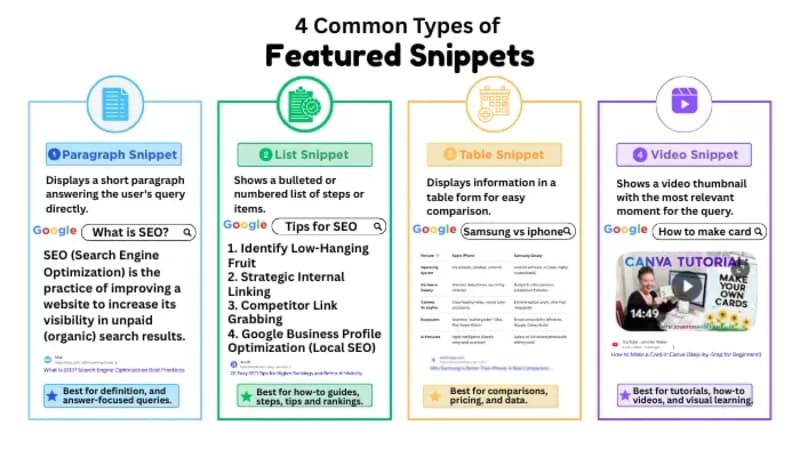
Featured snippets appear in several formats depending on the user's search intent.
- Paragraph Snippets
You’ll run into these more than anything else. Google grabs a short paragraph that answers your question right away. Search “What is API?”, and you’ll probably see a quick definition at the very top—easy and straight to the point.
- List Snippets
Whenever you’re looking for steps or rankings, you’ll see lists. So if you type in “How to optimize a website for SEO,” chances are, Google will pull a numbered or bulleted list right from a webpage and put it upfront for you.
- Table Snippets
Tables pop up whenever you want to compare stuff—pricing, features, and all that. If you search “SEO vs PPC comparison,” Google might show a table that lines up costs, features, and benefits side by side so you can scan the differences at a glance.
- Video Snippets
These appear when you’re searching for tutorials or how-tos. Say you search “How to install WordPress”. Google sometimes drops you right into a YouTube video at the exact moment that explains what you need. No fussing around.
What Are Google AI Overviews?
If you’ve done any searching on Google over the last few months, you probably noticed something different when you get to the results page at the very, very top (above the normal links)—AI Overview snippets. Unlike the old Google featured snippets (those just pulled out one paragraph/etc. from a single URL), AI Overview pulls information from various places on the web and combines them into one answer for you.
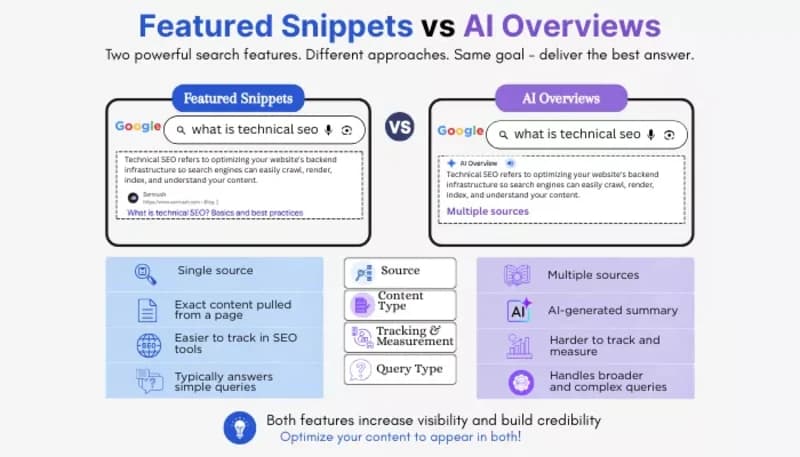
Simply put, featured snippets typically rely on a single source, while AI Overviews combine information from multiple sources.
In many cases, Google may still use content from featured snippets as one of the sources referenced within AI Overviews.
The reason Google launched this feature is to help answer more complex types of questions—it allows users to receive answers to their questions more thoroughly because they don’t have to go between multiple websites to get complete answers. Instead, searching Google now mimics having an actual conversation with someone and provides an answer directly in front of you.
This shift makes SEO Growth increasingly important because businesses need to build content and online authority that can remain visible as search becomes more AI-driven.
Featured Snippets vs AI Overviews
At first glance, they may seem similar, but they serve different purposes. Many discussions about featured snippets today focus on how they compare with AI-generated search experiences.
| Google Featured Snippets | AI Overviews |
| Uses a single source | Uses multiple sources |
| Displays exact website content | Generates AI summaries |
| Easier to track in SEO tools | More difficult to measure |
| Typically answers simple questions | Handles broader and complex queries |
| Shows a direct website citation | May cite several websites |
For example:
When someone searches for "What does 'Technical SEO' mean?" there may be a featured snippet produced by one specific website.
Whereas if someone queries "How does Technical SEO affect my rank?" Google's response could consist of an AI Overview that aggregates information from many sources considered authoritative.
Are Featured Snippets Still Important in 2026?
Certainly, there is much buzz surrounding AI Overviews, however, featured snippets still have a tremendous impact on search visibility. Many SEO professionals believe that pages earning featured snippets may also be well-positioned for visibility in AI-generated search experiences because both systems tend to reward clear, well-structured, authoritative content. As search engines like Google rely on high-quality, well-structured content to produce their answers/renderings. Ultimately, featured snippets assist in creating that high level of trust.
Featured snippets continue to provide value through:
- Increased visibility for brands
- Increased trustworthiness
- Improved click-through rates
- Increased voice search success
- Improved topical authority
Since voice assistants frequently pull answers from featured snippets, implementing voice search optimization strategies can further improve your chances of being surfaced in spoken search results.
Thus, although AI Overviews are being developed and released, they are not yet replacing Google featured snippets, they are simply becoming yet another layer in the overall search engine ecosystem provided by Google.
How AI Overviews Are Changing Search Results
A major shift in user behavior is that people are increasingly getting answers instantly via the search results page instead of clicking through to a web page. Consequently, businesses need to focus not only on rankings but also on becoming trusted sources that search engines can confidently reference.
Google's official announcement regarding AI-driven search experiences states that searchers are asking more extensive and complicated questions than before. As a result, many content producers will be incorporating additional insight and context into their answers, rather than solely focusing on building keyword-rich content.
Learn more here:
https://blog.google/products/search/generative-ai-search/
The primary goal should not just be focusing on optimizing your site for search engines but also to consider what a user wants when searching. Sites that have content that provides direct answers to a user’s question, demonstrate expertise in a particular area of field of expertise, provide a Unique Value Proposition(Copy) will continue to give you some competitive advantage(s); even as the methods users may utilize when searching evolve or change over time.
How to Optimize Content for Featured Snippets and AI Overviews
When writing strategically for an audience, such as internet users searching for solutions to their problems (i.e., using search engines), it's important to answer users' questions directly. Internet users want answers quickly. So, when writing about a question-based keyword, list the answer immediately following the heading.
For example:
What is Local SEO?
You could say "Local SEO is a technique used to increase a company's visibility on local search engines."
This approach makes content easier for both users and search engines to understand.
Use Structured Headings
Well-structured headings and organized content allow both users and search engines to navigate your content more easily.
- Use headings (H2)
- subheadings (H3)
- bullet points
- numbered lists
This improves readability, and increases your chances of being included in a featured snippet.
Demonstrate Experience and Expertise
Google will now place greater emphasis on first-hand user experience. You will need to look beyond general and 'generic' types of recommendations and incorporate case studies, examples and user experiences directly.
For example:
"Website speed matters"
You would write;
"After reducing image sizes and implementing cache on a client’s website, we saw a 38% decrease in load times along with increased conversions and decreased bounce rates."
Providing specific examples of your insights is paramount to building credibility.
Add Statistics and Credible Sources
You might want to include additional information such as reliable data (statistics) or reputable sources to back up your assertions in addition to real-life instances. An example would be the latest Search Engine Journal State of SEO report. The report indicates that the top three elements influencing the overall ranking for SEO professionals are: Overall quality of content, user experience and credibility.
Source:
https://www.searchenginejournal.com/state-of-seo/
Statistics make content more persuasive and trustworthy.
Create Comprehensive Content Clusters
Instead of creating separate individual pieces of content, think about how you can create many related articles on the same subject.
Examples include Technical SEO, On-page SEO, Local SEO, E-commerce SEO, and SEO Audits.
When you create those articles and add links between them, it gives you more topical authority.
Implement Schema Markup
Schema Markup is a great way for search engines to understand your content better. By adding FAQ Schema, How-To schema and Article schema you will improve your visibility and the chances of being displayed in a rich snippet.
Common Mistakes to Avoid
Many websites continue to commit common optimization errors.
Avoid:
- Keyword stuffing
- Trying to write for search engines, not users
- Publishing thin content
- Ignoring Users’ search intent
- Utilizing unclear heading structures
- Neglecting to update content
Google doesn’t reward a page just because it has keywords. Google rewards pages that solve problems.
Future of Featured Snippets and AI Search
The evolution of search is moving towards a conversational, AI-powered experience. Understanding the broader overview of artificial intelligence can help marketers prepare for the future of search visibility.
One thing hasn't changed: Google still requires reliable content sources.
All of the information that may appear in a featured snippet, an AI Overview or in a regular search could only be based on quality content. Successful websites will continue to demonstrate expertise, publish accurate information, provide strong user experiences, and keep content updated. Ultimately, the future of SEO is less about manipulating algorithms than it is about being a trusted answer.
As AI continues to influence how people discover businesses online, combining AI Automation Solutions with a strong content and SEO strategy can help businesses work more efficiently while keeping their digital presence competitive.
One Final Thought
Now Featured snippets won't dominate the search result, once they did. But that doesn't mean they are dead. With AI overviews, optimizing for featured snippets remains important, because the same quality which helps to earn a place in snippets - clarity, structure, and authority is important for current search experience.
Your concern should be delivering high-quality content, answering user's questions and value-driven. And this will remain as the foundation of the search visibility. To gain visibility within AI Overview and Featured Snippet environments, you will need to do more than simply follow the old rules of SEO. A strong SEO Growth approach, supported by a well-structured Business Website, can help turn this visibility into a better overall digital presence.
If you'd like expert guidance on optimizing your content for both, we'd be happy to help.